Silent Spring and Planet of Giants
How Rachel Carson's Silent Spring inspired Planet of Giants (1964) - Doctor Who's first political story, and the pesticide scandal Britain lived through.

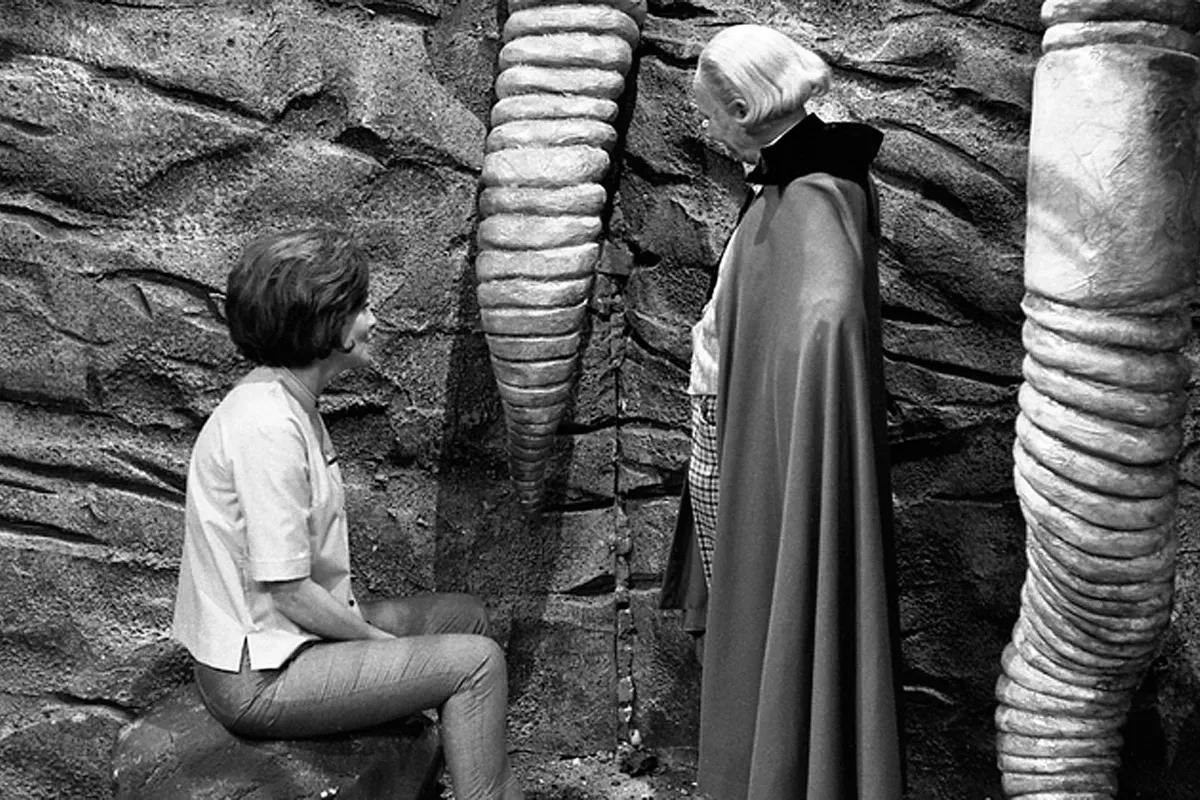
In 1962, a book was published that the American chemical industry found so threatening that a co-ordinated campaign was created to discredit it. It involved multiple chemical companies, trade associations and public relation firms, reportedly costing upwards of $250,000 ($1.5 million today) and began before the public had the chance to read it. Two years later, the same book became the inspiration for an early Doctor Who serial: Planet of Giants, broadcast on the 31st of October 1964. A mere ten stories in Doctor Who was getting political. This is Behind the Episode.
Rachel Carson’s Silent Spring opens with a short, fictional sketch she called “a fable for tomorrow” - where a composite town has lost their birds, and their streams have emptied of fish. This town doesn’t exist - but every incident described had actually happened somewhere in America. The book describes the dangers of pesticides and insecticides, the damage that happened over the 50s as they were used in large quantities for the first time.
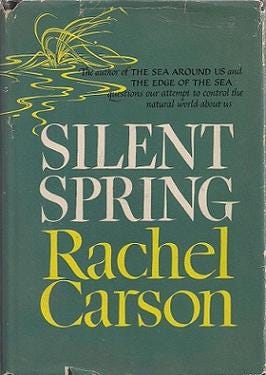
Its central focus is DDT (dichlorodiphenyltrichloroethane), which by the early 1960s was the most widely used insecticide in the United States and, in the popular imagination, more or less harmless. Carson shows that it was the opposite. DDT is fat-soluble, which means that it does not break down in the body, but accumulates in fatty tissue and concentrates as it moves through the food chain. Carson described how hay dusted with DDT residue at seven to eight parts per million, fed to a dairy cow, which produces milk at roughly three parts per million. That milk is concentrated into butter, which can reach up to sixty-five parts per million - because butter is almost entirely fat, and the DDT has nowhere else to go.
While sixty-five parts per million will not kill, the danger the book highlights is not a single event, but the danger of prolonged exposure. And it does not end with butter. Of course, no one set out to put the DDT in the butter, but it arrived there through a sequence of invisible agricultural steps because no one was tracking where it went after the (usually airborne) spray.
Arsenic was used to prove a similar argument. Its history as a poison goes back centuries, but by the 1960s it was being applied to large swathes of farmland, with documented records of harm that included the collapse of beekeeping in parts of the arsenic sprayed cotton fields of the American South. It causes the same chain as DDT - chemicals introduced into a living system do not respect the intention of the sprayers, it moves and spreads throughout the ecosystem causing intensive harm.
Underlying all of the chemistry is an argument that Carson regarded as the most important: the public had a right to know what was being done to the world that we all inhabit - that we get our water and food from, and that we are affected by everyday.
“We have subjected enormous numbers of people to contact with these poisons, without their consent and often without their knowledge.”
— Rachel Carson
She borrows a line from the French biologist Jean Rostand to make the point as blunt as she can: the obligation to endure gives us the right to know. It is this precise argument that Doctor Who would later focus on.
Carson did not set out to write Silent Spring. The book began with a letter, in January 1958, from a friend, Olga Owens, who had watched a state aerial spraying programme kill birds across her bird sanctuary in Massachusetts, and had already published her own furious account of it in a Boston newspaper. She wrote to Carson asking whether anyone in Washington might actually listen. Carson, by her own account, was not initially eager to take the project on.
However, she persisted. In 1960, as she was drafting the chapters dealing with chemically caused cancer - Carson was herself diagnosed with breast cancer. She underwent a radical mastectomy that April, followed by radiation treatment. She kept the diagnosis secret for the rest of her life, as she finished, published and defended the most important nature book of the 20th century.
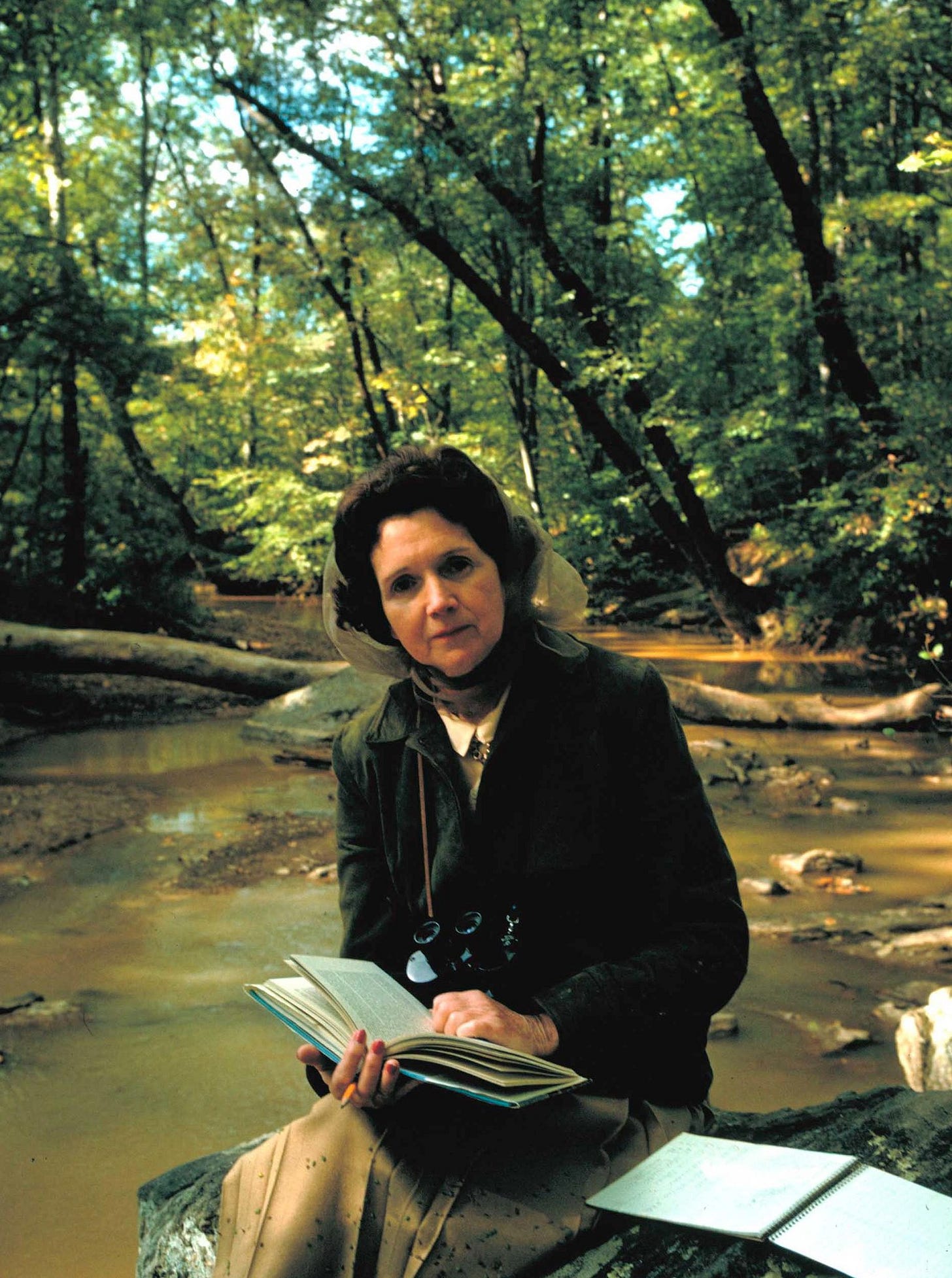
Carson died on the 14th of April 1964, less than two years after the books publication. She never saw the full impact that her book caused in the agricultural and political landscape, or the differences she made to the health and safety of ecosystems over the world.
What she did live to see was the fight that the book provoked on arrival. Silent Spring was serialised in the New Yorker starting in June 1962, months ahead of publication, and the chemical industry’s intense response began before the finished book had hit shelves. The National Agricultural Chemicals Association doubled its public relations budget and distributed thousands of copies of negative reviews to newspapers across the country. Editors were warned that favourable coverage might cost them advertising revenue from chemical manufacturers.
Monsanto’s contribution remains the most striking part of the campaign to discredit Silent Spring. In late 1962, the company published and distributed five thousand copies of a pamphlet titled “The Desolate Year”, a parody of Carson’s “fable for tomorrow”, in which the absence of these pesticides leads to an America overrun by insects and famine. Much of the other criticism directed at Carson personally had little bearing on her science. She was was repeatedly described as a hysterical, “bird-and-bunny” enthusiast unqualified to comment on serious chemistry, despite the fact she had a master’s degree in zoology and a sixteen-year career as a working government scientist with the US Fish and Wildlife service. At senate committee hearings on pesticide regulations in 1963, an industry spokesman reportedly drew the distinction plainly: men could be relied upon to assess these questions dispassionately - women could not.
None of it worked. In May 1963, US President Kennedy’s own Science Advisory Committee published a report substantiating Silent Spring’s central findings, going further with what would become known as Recommendation Five: that the elimination of persistent toxic pesticides should be the explicit policy goal. Within fifteen years of its publication, Silent Spring had reshaped how an entire country regulated air, water and land. In 1972 DDT was banned for agricultural use in the US outright. In 1976, the Toxic Substances Control Act extended the same logic further, eventually leading to restrictions on every chemical Carson had named as dangerous.
The British edition of Silent Spring was published on the 14th of February 1963, launching into a country that had already been having a quieter version of the argument for almost a decade. The Nature Conservancy had been warning Parliament about pesticide harm to wildlife as early as 1952 and by 1960 the National Parks Commission’s Annual recorded that “growing public concern about the effects of the use of toxic chemicals on wild life,” and that “mysterious deaths of large numbers of birds, allegedly due to the use of toxic sprays” had occurred the previous year.
Between 1956 and 1961, the concern had peaked into a domestic pesticide crisis: large numbers of wood pigeons, pheasants and partridges were found dead across eastern England, alongside around 1,300 foxes, dogs, cats and badgers. All of the deaths were traced back to a seed dressing called dieldrin. The government’s response was to seek promises from manufacturers, distributors and farmers that they would not use the dieldrin seed dressings on spring-sown grain. As the government noted in the House of Lords in July 1961, they had no reason to think that the promises would not be “faithfully observed”. As a result there was no ban nor legislation, just hope that a promise would be held.
The Nature Conservancy’s own review of Carson’s book, when it arrived in the UK in 1963, was accordingly measured rather than alarmed. Reviewers were concerned with the situation in America, but there was only some conclusions of wider applications. Britain, in other words, already knew. The question was whether knowing was enough. This would come to a head the very same time as the publication of Silent Spring, in a small Kent village called Smarden.
A pesticide factory in Smarden, Kent - operated by a division of the company Rentokil - had been manufacturing a chemical called fluoroacetamide, originally developed out of the wartime chemical weapon research. Through 1963, waste from the site contaminated surrounding ditches and ponds. Dogs started dying in January, the sheep, then an entire herd of cows. A local vet named Douglas Good traced the cause to the factory and ran straight into a wall: the company denied any wrongdoing and the government moved slowly.
In September of 1963, a second poisoning broke out in Merthyr Tydfil in Wales. The same chemical - used this time as a rodent poison - contaminated pet food and killed an estimated seventy-five to a hundred dogs and cats. By early 1964, a case of suspected human poisoning had emerged. Fluoroacetamide was banned as an insecticide that February, and contaminated soil was removed and dumped at sea. The affected farmland was not cleared for use again for another year.
“The house-martins never came this spring, and there was no bird song in the hedgerows… The subject of Rachel Carson’s book Silent Spring had become a reality here in the heart of the Garden of England.”
— Douglas Good, Kent & Sussex Courier, January 1964
The BBC drew the same comparison as Douglas Good a few months earlier. The Home Service agricultural correspondent, Archie MacPhee, told listeners that the Smarden and Merthyr Tydfil poisonings would likely shift British attitudes towards pesticides more decisively than Carson’s book. When the use of toxic chemicals was debated in the House of Lords in the spring, copies of Silent Spring reportedly sat beside both dispatch boxes, with the book serving as a point of reference for almost every speaker in the debate. What Smarden exposed was a gap in the way Britain ran its processes; public alarm was running a long way ahead of institutional confidence. This, more or less, what was to be highlighted one Saturday on teatime television.
The man who adapted Silent Spring for Doctor Who is usually described as an Oxford-educated historian, but this wildly under describes his background. Louis Marks read history at Balliol College, Oxford, where his tutor was the Marxist historian Christopher Hill, one of the most significant left-wing historians Britain produced that century. By his own later account, Marks was, at the time, a member of the Communist Party, much influenced by Hill. He went on to translate the writings of the Italian Marxist philosopher Antonio Gramsci.
His foray into television came through his wife, Sonia, who worked as a personal assistant to the American producer Hannah Weinstein. Weinstein’s company made The Adventures of Robin Hood, and used the series in part to cover employment for American writers blacklisted in Hollywood over alleged Communist sympathies. Marks wrote for the same series in the late 1950s as his first TV writing credit. In 1964 Marks was commissioned to write a story for Doctor Who’s second season. The premise he got was pretty straightforward - a malfunction causes the TARDIS to land, except the crew have been shrunk to the size of insects.
The shrinking premise was not originally his. A BBC staff writer named CE Webber had proposed a miniaturisation story a year earlier, under the title “The Miniscules”. A second writer, Robert Gould, subsequently took up and abandoned the same idea. By the time it reached Marks, it had failed twice. In conversation with script editor David Whitaker, Marks later recalled that it “suddenly hit” him that the abandoned shrinking premise could be combined with a subject he had been reading about, and found himself unable to put down.
“I wanted to deal with the question of ecology and the indiscriminate use of insecticides and other agents which interfered with the balance of nature. At that time [1964], this was a comparatively new matter of concern, and had been enormously boosted by the publication of a book called Silent Spring by Rachel Carson”
- Louis Marks, Doctor Who: An Adventure in Space and Time, Issue 11
Planet of Giants opens the second season of Doctor Who with something that was relatively novel on BBC TV. The TARDIS doors open mid-flight, causing a malfunction, and when the Doctor, Ian, Barbara and Susan step outside later, they find themselves not on an alien world but in an ordinary English garden. Except for one thing - they are an inch tall. When they explore, they find a garden full of dead creatures, dead worms and dead bees. The seemingly normal garden is completely wiped out.
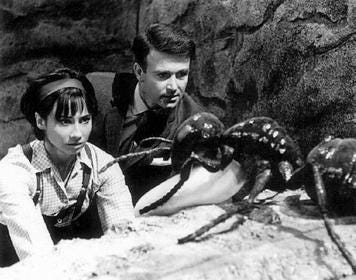
The crew find out that the cause is a pesticide called DN6. Its inventor, Forester, wants it on shelves by Monday. The one person standing in his way is a government scientist named Farrow, who has seen the data and knows what DN6 actually does. Forester murders him rather than let the report reach anyone that could act on it. And it gets worse - Barbara becomes poisoned by the chemicals, and the TARDIS crew has to bring the murder to justice and inform the authorities despite their tiny size.
Mark Wilson, in his essay on Doctor Who and environmentalism, notes a number of direct textual parallels: Susan’s observation that “so many different things are dead... it’s all so indiscriminate” echoes Carson’s own recurring use of that word, most pointedly in her tenth chapter, titled “Indiscriminately from the Skies.” The Doctor’s reply that bees and worms are “vital to the growth of things” maps closely onto Carson’s own passages on soil ecology and pollination. DN6’s effects are described in the episode as “everlasting” - language that parallels Carson’s central argument about the persistence of fat-soluble chemicals in the food chain.
But the main focus of Silent Spring is echoed in the character of Farrow. The public has an obligation to live in the environment around them - and there for they have a right to know what that risk actually is, and those that are in a position to conceal it have a specific and serious responsibility. “The obligation to endure,” she writes, borrowing from Jean Rostand, “gives us the right to know".” The scene in which Forester offers Farrow a bribe, and Farrow refuses it - “This isn’t business. This is science. The formula is unacceptable, and I can’t… allow DN6 to go into production” - is not really a scene about a bribe. It is Rostand’s line dramatised - it’s about lies and concealment, not just the chemistry.
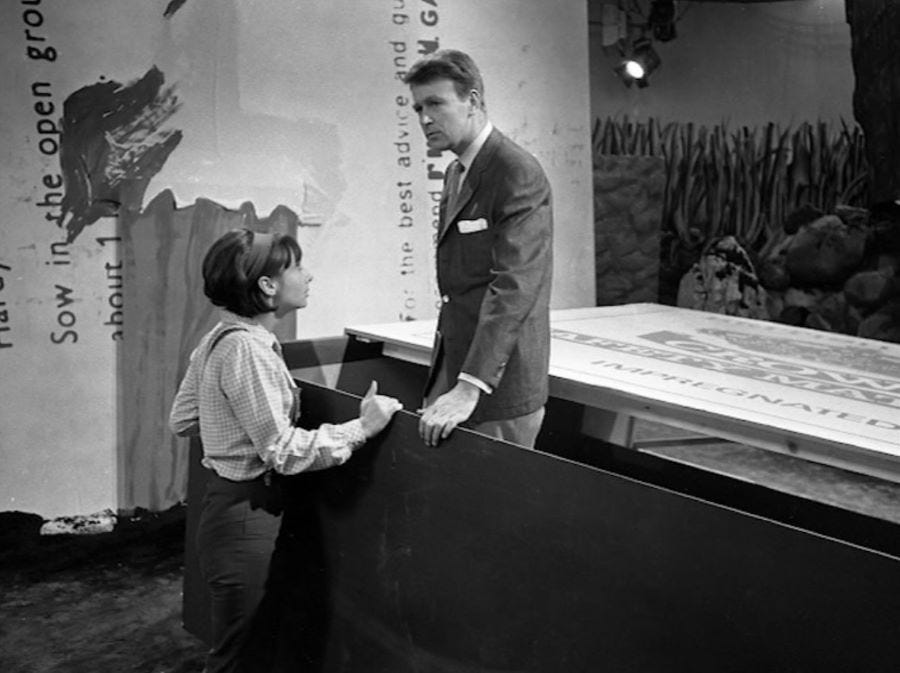
Lindy Orthia, in her survey of environmental themes across Doctor Who’s history, observes a striking difference between the giant, mutant ants of contemporaneous American “big bug” films such as Them! (1954) and the insects encountered in Planet of Giants: here, the oversized creatures are characterised throughout as innocent victims, “vital to the growth of things,” rather than as threats to be eliminated. Their apparent giant size results from an altered point of view rather than mutation - a structural choice that places the burden of change on the human characters, not on the insects. Planet of Giants, on this reading, is a quiet rebuttal to the insect-as-monster genre conventions around it, rather than a continuation of them.
The Radio Times preview of the 29th of October 1964 sold the story entirely through Gulliver’s Travels, describing the crew as learning “what Gulliver must have felt like when he landed on the island of Brobdingnag to find himself suddenly become a manikin plaything for a lady.” Not a word about insecticides, ecology, or anything resembling contemporary controversy.
The Irish Independent’s television column, published the week after broadcast, noted that the show had returned with undiminished grip, praised its inventiveness, and then complained that nobody had explained why Ian couldn’t simply have climbed back out of the matchbox before it was lifted by a Brobdingnagian hand. The political content went entirely unremarked. Inside the BBC, Director-General Hugh Greene watched it privately and came away unimpressed, not because of anything political, but because he thought it was a weak story and said so in internal notes, adding that he looked forward to the Daleks coming back the following week. The BBC’s own Audience Research Report singled out the props and special effects for praise.
This is in direct contrast to the response that the next big environmental story got. In 1973, when the show made The Green Death, set in a Welsh valley with a villainous oil company pumping toxic waste into an old coalmine. A real chemical company named Gamlen wrote to the BBC to complain that the fictional “Global Chemicals” bore an unflattering resemblance to their own branding. However, no such response ever came after Planet of Giants. It would take Marks’ own retrospective account decades later before Planet of Giants was routinely described as what it actually was - Doctor Who’s first explicitly political episode.
A book that a chemical industry spent $250,000 trying to bury ended up inspiring Saturday teatime television, inside a story about getting very small. The industry needn't have worried - nobody clocked it. But Louis Marks knew what he was writing, and Rachel Carson knew what she'd written, and somewhere in a Kent village Douglas Good knew what he'd found. Planet of Giants is Doctor Who doing something it would keep doing for sixty years: taking the thing everyone already knows is happening and putting it somewhere a child might see it, dressed up just enough that nobody has to admit it's real.
Sources
Carson, Rachel, Silent Spring (Houghton Mifflin, 1962)
Clark, J.F.M., “Pesticides, Pollution and the UK’s Silent Spring, 1963–1964,”
The Royal Society Journal of the History of Science 71 (2017)
Orthia, Lindy A., “Paradise is a little too green for me,” Colloquy 21 (2011)
Wilson, Mark, “Doctor Who and Environmentalism in the 1960s and Early 1970s,” in Fleiner & October (eds.), Doctor Who and History (McFarland, 2017)
“Louis Marks,” obituary, The Times, 25 September 2010
Marks quoted in Doctor Who: An Adventure in Space and Time, issue 11
Radio Times, 29 October 1964, and Irish Independent, 7 November 1964, both accessed via The Doctor Who Cuttings Archive (cuttingsarchive.org)
Lear, Linda, Rachel Carson: Witness for Nature (Henry Holt, 1997).