Cadet Sweets - Dr Who and the Daleks
A look at the elusive 1964 Dr Who and the Daleks cigarette cards, their unusual stories, and their place in the earliest years of Doctor Who merchandising.

Dr Who and the Daleks
Cadet Sweets Merchandise

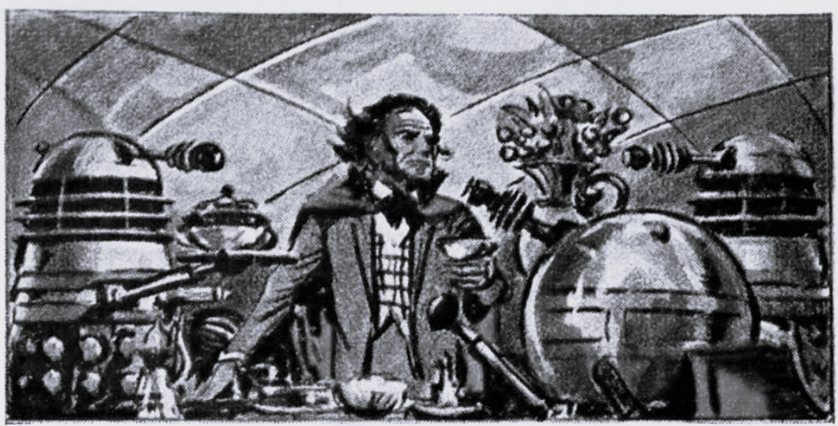
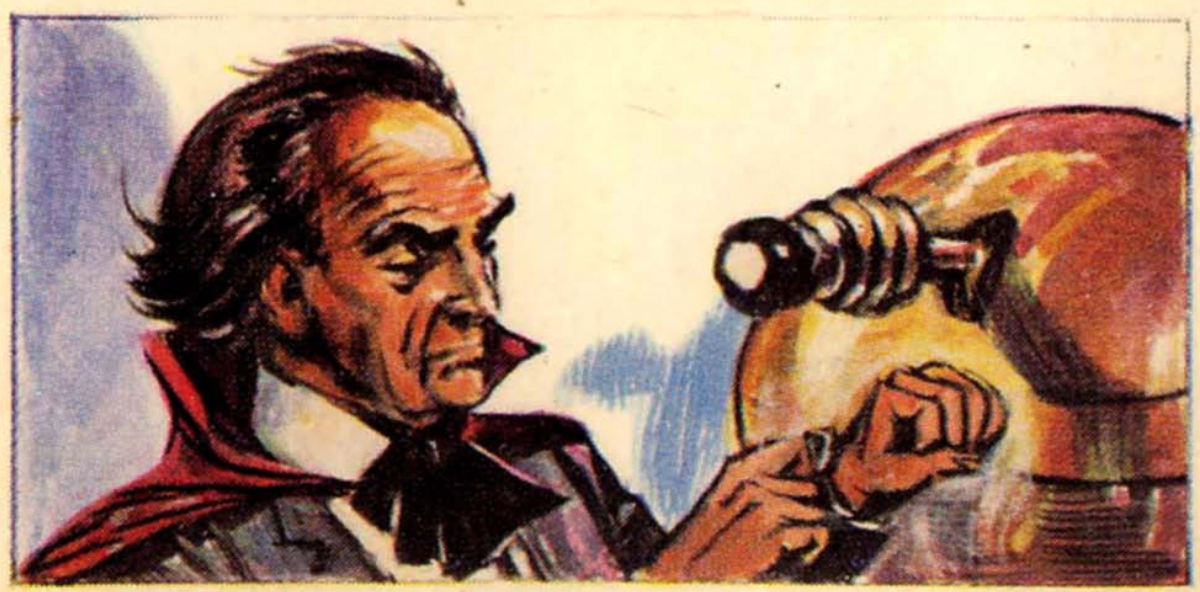
They could not have known that an Earth-man would go near the machine, so the death rays had no effect on humans... "apart from being hot," laughs Dr Who at the banquet held in his honour that evening!
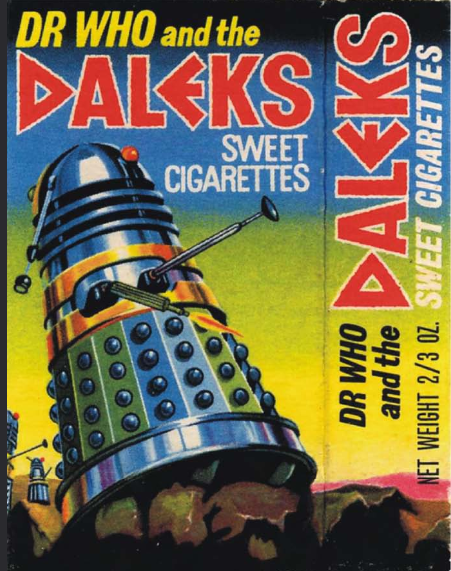
Between the instant popularity of The Daleks and the release of the film adaptation Dr Who and the Daleks, it was almost inevitable that Doctor Who would begin to get tie-in merchandise. The first of these to combine both a product and a story was Cadet Sweets - a Berkshire company best known for producing candy cigarettes packaged with collectable cards. Traditionally, each pack of ten white candy sticks contained a card, with illustrated artwork on one side and a small part of a story on the other.
The Doctor Who set contained fifty different cards, covering two different short stories collectively called “Dr Who and the Daleks”. Although the writer is unknown, the artwork was illustrated by Richard Jennings, who also contributed to The Dalek Book. The exact date these packs were released is unknown, but it makes reference to the aforementioned Dalek Book, released in September 1964, which suggests October or November.
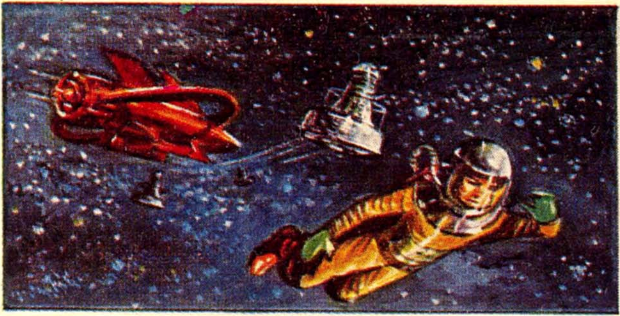
The cards are the first original prose stories to feature the character of the Doctor, arriving when much of the non-televised material surrounding the series had been focused on the Daleks. The Daleks themselves had rapidly eclipsed the programme’s lead character in popularity at this time - getting not only their own short story and comic collection but the first Dalek Annual as well.
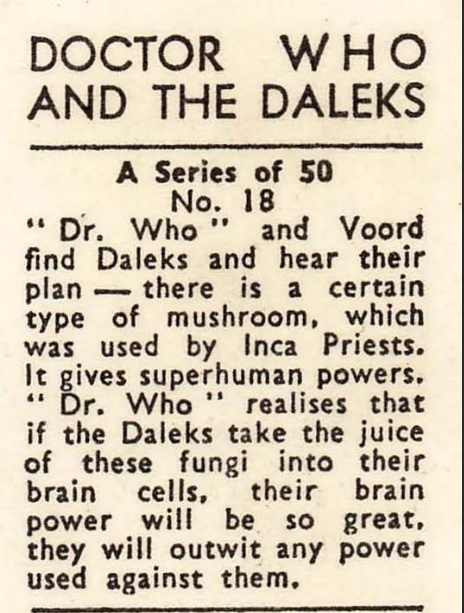
The first story, spread across the first twenty-five cards, “Dr Who” travels to the planet Marinus. There is a great war between the Voord and the Daleks. However, after the arrival of the Dr, they team up to capture him, attempting to find out the secret of Ulkron travel. Both factions are searching for a mysterious force on Earth known only as the “Great Power”, and although the Doctor attempts to warn humanity of the coming threat, he is unsuccessful. During the journey to Earth, the Doctor deliberately sows distrust between the Daleks and the Voord, eventually provoking violence aboard the ship. The ship crashes, and Dr Who evacuates with the chief Voord. After landing in the jungle, Dr Who discovers that the Daleks believe that the mystery “Great Power” will make them intellectually superior. He tricks them into absorbing poisonous mushrooms which end up killing every Dalek, and Dr Who is rescued by Earth forces.
The second story begins when Earth discovers a rogue Dalek who has been sent to fetch Dr Who. The Daleks need him to come to Skaro and fix a superintelligent machine capable of producing deadly Neutronium. It has turned against its creator, destroying anyone trying to stop it. Believing only the Doctor can stop the machine, the Daleks transport him to Skaro. There, he discovers that the machine’s lethal rays affect Daleks but not humans, allowing him to reach and deactivate it safely. To show their appreciation, the Daleks celebrate his success by holding a great banquet in his honour.
These stories show an interesting glimpse into an early point of Doctor Who (before even The Dalek Invasion of Earth) where it is so early that a lot of what we recognise as “Doctor Who” is not yet developed. This story, like a lot of early stories, suggests that the Doctor is actually human, from Earth. The Daleks themselves are vaguely characterised as usual for the first story - but wildly different in the second, where they throw the Doctor a party. The contrast demonstrates how fluid the series still was in 1964, even as its imagery and monsters had already become instantly recognisable to the British public.
The first story has a lot of consistency with the published Dalek Book, which was written and illustrated mainly by the same team. The second story however depicts the Daleks less as the rigidly defined villains they would later become and more as adaptable villains capable of just filling whatever role they have to.
As artefacts from the earliest period of Dalekmania - produced before Doctor Who’s identity had fully formed - they allow an interesting glimpse into how the series was seen in the public eye. Physically, these truly are a rarity, with it being close to impossible to purchase a full set. Digitally, these have been collected together by Colin Hall and Mick Young, and uploaded as a full set to the Internet Archive. These have been archived with our collections.