Lost Media - Doctor Who and the Daleks in Seven Keys to Doomsday

Doctor Who and the Daleks in Seven Keys to Doomsday
Stageplay

"A special effects team is tackling the design and construction of neutron blasters, laser swords, electronic force-fields and a crystal-tuned 'Doomsday Weapon."
— Porirua Little Theatre promotional flyer, 1984
The gap between Pertwee and Baker is usually treated as an empty stretch of 1974 in which nothing much happened, six months of the programme being off the air while the country waited to see what the new one would be like. It was not empty. For four weeks over that Christmas there was a full Doctor Who story running in the West End, with a regeneration, a set of new companions and the Dalek Emperor, written by the man who had been script editing the television series until a few months earlier and licensed by the BBC.
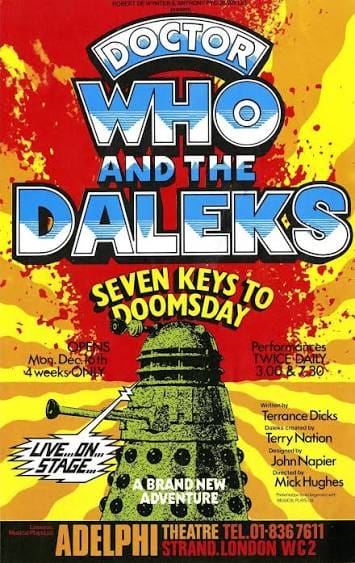
The play opened on the 16th of December 1974, twelve days before Tom Baker's first television episode, which meant that for four weeks the only new Doctor Who anyone could actually go and see was happening twice nightly on a West End stage. Terrance Dicks wrote it, having wanted a stage version for years and getting his chance when two producers, Robert de Wynter and Anthony Pye-Jeary, arrived at the production office with the same idea. Barry Letts was seconded from the BBC as production coordinator, John Napier was the designer and James Acheson handled the monsters, so this sat a good deal closer to the programme itself than most licensed spin-offs of the period ever managed.
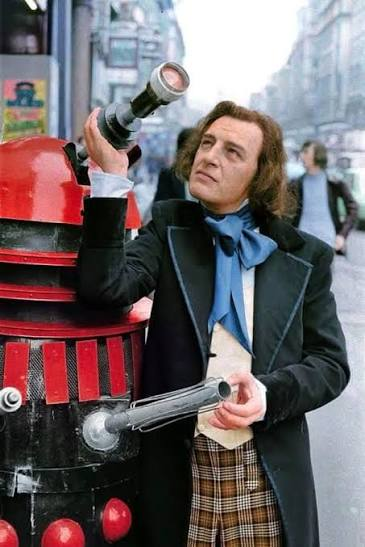
Rather than approach Pertwee or Baker, the producers built their own Doctor out of all the previous ones, Peter Cushing included, and cast Trevor Martin, who had already appeared on television as one of the Time Lords sitting in judgement in The War Games. The play began with Martin dressed as the Third Doctor, wig and collar and all, collapsing on stage while rear-projected screens cycled the faces of Hartnell, Troughton and Pertwee into his own, at which point he dropped the wig and stood up as somebody else.
Jenny and Jimmy, the companions for the play, spend the opening minutes sitting in the audience as ordinary members of the public and only rush the stage once the Doctor collapses. Jenny was Wendy Padbury, who played previous companion Zoe, and Jimmy was James Matthews. The Daleks' also had odd crab-like servants, who Dicks' wanted to call Crocs, but instead a competition was run in a national paper to replace it, with Clawrantulars winning. The story sends the three of them to Karn to find the seven crystal keys before the Daleks do, and Dicks liked the name enough to reuse it eighteen months later in The Brain of Morbius.
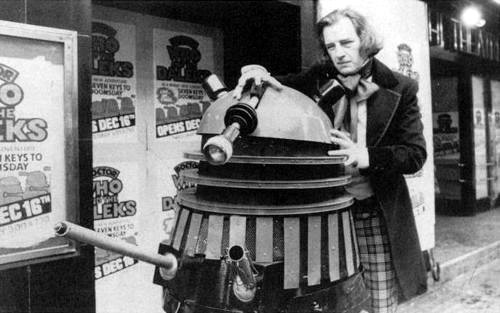
It was, by the standards of a stage show, enormous. Two thousand slides were back-projected onto screens at the rear of the stage, and the scenery turned out to be too big for a lorry and for most regional theatres, which finished the planned tour before it started. The run itself was finished by the IRA bombing campaign then underway in London, which kept parents from bringing children into the West End, so a production costing thirty-five thousand pounds came back with just under twenty-seven and a half, the Blackpool dates were dropped, and that was that.
The script survived, though, and licensed productions kept turning up. The Buxton Drama League staged it at Buxton Opera House in December 1981 with Colin Jones as a Doctor one local reviewer described as looking like Hartnell, dressing like Pertwee and acting like Troughton, working from the original script and therefore restoring both Dave and the Crocs. Three years later it left the country for what is believed to be the only time.
Brian Hudson, a former BBC newsreader who had gone home to New Zealand after a decade in London, had seen the Adelphi production and was looking for something in 1984 that children might want to watch. He sent for the script, read it, decided it was impossible, and wrote to Terry Nation anyway on the strength of having met him once at Television Centre. Nation said yes, the BBC said yes, and somebody at the BBC posted out a construction manual with the dimensions of the TARDIS and the Daleks in it.

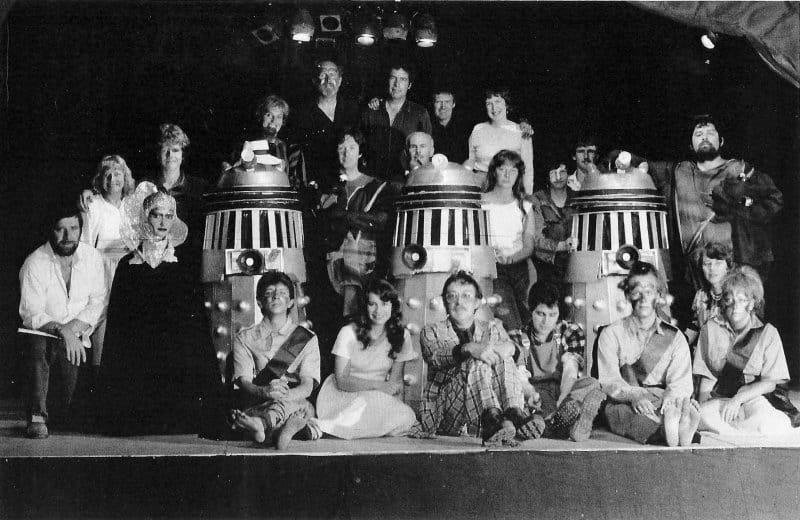
Seven Keys to Doomsday opened at the community hall in Titahi Bay on the 24th of November 1984, almost twenty-one years to the day after the programme began, and played ten performances. Michael Sagar's Doctor arrived in a light chequered suit and a black moustache, cast because Hudson wanted somebody slightly fey and faintly off the planet in the manner of the second Doctor, and tall enough to hold a stage against three Daleks, which Hudson compared to acting opposite dogs. Those Daleks were built to BBC dimensions out of cardboard, tin and timber, with a plastic bowl for the dome and hemispheres made from the little plastic eggs that women's tights came in at the time, which required the entire society to buy their tights in a particular format and then hand over the packaging. The voices came from a modulator the crew built themselves off a circuit diagram in an electronics magazine, on the reasonable grounds that a Dalek has to sound right or it is not a Dalek. The Clawrantulars were bulked out with seven or eight layers of foam and could only breathe through the mouth, and suffered for it. The TARDIS was a police box in front of a curtain, a blackout, and a console room waiting behind. The regeneration was the one thing Hudson didn't attempt.
Big Finish adapted the play for audio in 2008 with Trevor Martin back in the part he had originated thirty-four years earlier, and that recording is how most people have met the story, but it is not the play and was never going to be. The regeneration, the two companions coming out of the stalls, the two thousand slides, three Daleks made of tin and tights packaging in a hall in Titahi Bay: none of it was recorded by anybody, and there is nothing left now beyond the paperwork and the people who were in the room.
Sources: Graham Howard, "The Dalek Invasion of Porirua: 1984", incorporating an interview with Brian Hudson conducted 29 October 2000; press cutting on Trevor Martin, December 1974; Porirua Little Theatre programme and promotional flyer, November 1984.